Risk-Based Approval: Tailoring Oversight to Your AI Agent's Context
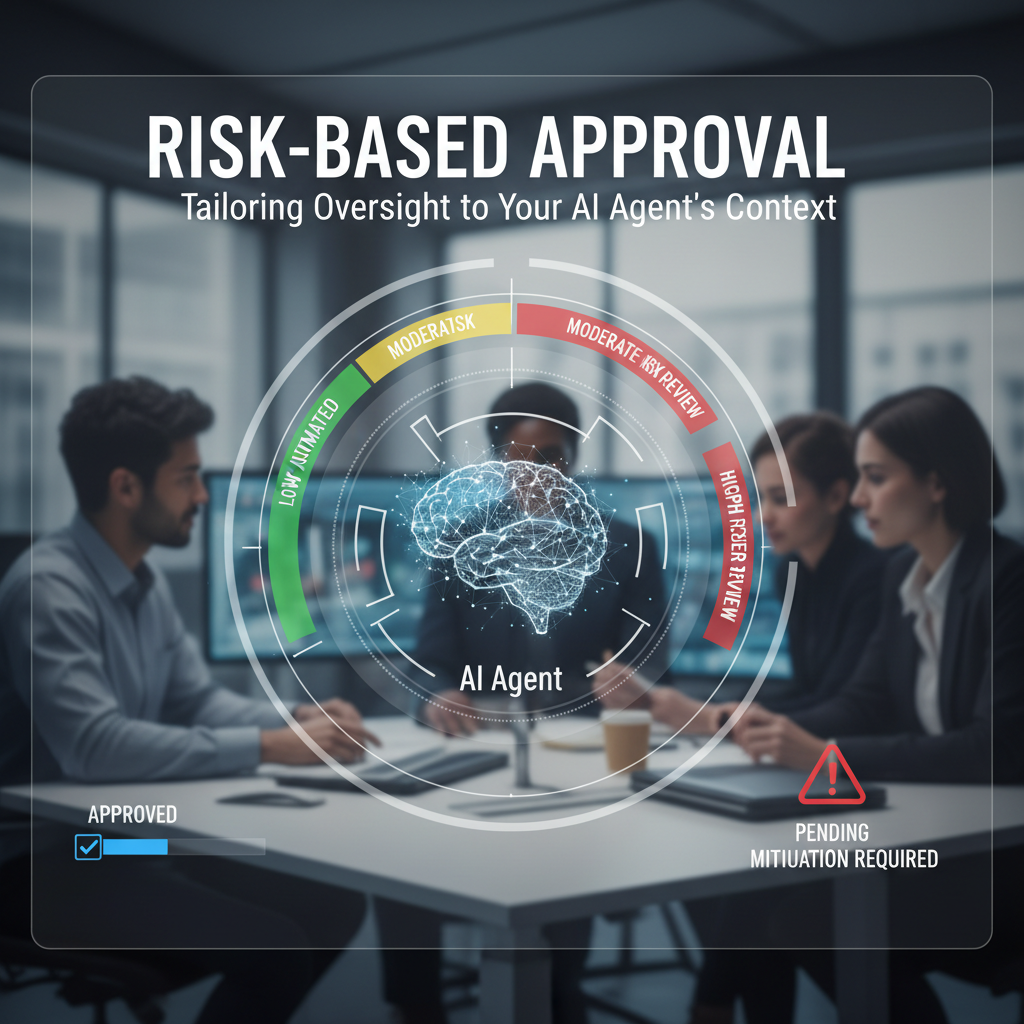
The proliferation of autonomous AI agents promises unprecedented efficiency, yet it introduces a critical challenge: how do we maintain control, ensure compliance, and safeguard against unintended consequences? The traditional "approve all or reject all" approach to AI decision approval is rapidly becoming obsolete. Enterprises in 2026 face complex regulatory landscapes like the pending AI Act and demand adaptive AI governance that can intelligently prioritize human intervention. This is where risk-based approval AI becomes not just beneficial, but essential.
Imagine treating every AI agent's decision with the same level of scrutiny, whether it's drafting an internal memo or executing a multi-million dollar financial transaction. This blanket approach is inefficient, costly, and ultimately unsustainable for scaling AI operations. Instead, a nuanced strategy is required, one that intelligently assesses the potential impact of an AI agent's action and allocates human oversight accordingly. This article will explore the limitations of generic approval processes, delve into the implementation of dynamic risk-based workflows, highlight AgentTask Pro's unique contextual approval logic, and demonstrate how this paradigm shift optimizes human effort where it truly matters.
The Limitations of One-Size-Fits-All Approval
As AI agents become more sophisticated and deeply embedded in business processes, a uniform approval mechanism quickly hits its ceiling. Treating every AI action as equally critical or non-critical leads to either overburdened human reviewers or unmanaged risks. This creates a significant bottleneck in AI operational efficiency and can undermine the very benefits automation is supposed to deliver.
The Cost of Inefficient Oversight
Requiring human approval for every single AI agent task, regardless of its impact or complexity, is a recipe for inefficiency. Human reviewers get bogged down in mundane approvals, experiencing decision fatigue and potentially overlooking genuinely critical issues. This not only inflates operational costs but also slows down the entire AI workflow, negating the speed advantages of automation. Conversely, a lack of oversight for high-risk decisions can lead to significant financial, reputational, or compliance pitfalls. The balance is delicate, and a static approach simply cannot achieve it.
When Simple Approval Fails
Consider an AI agent processing insurance claims or approving loan applications. A simple "approve/reject" workflow might suffice for low-value, standard cases. However, when faced with an unusual claim, a high-risk application, or a decision impacting vulnerable individuals, a binary choice is inadequate. Such scenarios demand deeper contextual reasoning AI and potentially multi-layered human review. Without the ability to dynamically adjust the approval process based on inherent risk, organizations leave themselves exposed to errors, biases, and regulatory non-compliance. The complexity of modern AI operations calls for a more intelligent system.
The Need for Nuance in AI Decisions
The reality of enterprise AI is that not all decisions are created equal. Some AI actions carry minimal risk and can be fully automated or approved via sampling. Others involve significant financial implications, sensitive data, or ethical considerations, requiring rigorous human-in-the-loop (HITL) oversight. Ignoring these nuances means either over-applying human resources where they are not needed or under-applying them where they are crucial. Effective adaptive AI governance demands a system capable of discerning these differences and routing decisions through appropriate human scrutiny.
Implementing Dynamic Risk-Based Workflows
Transitioning from generic to risk-based approval requires a structured approach to classify AI tasks and design workflows that respond intelligently. This dynamic strategy ensures that human experts spend their time on what truly matters, fostering both efficiency and robust governance.
Identifying & Classifying AI Risk
The first step in building effective risk-based approval is accurately identifying and classifying the inherent risks associated with different AI agent tasks. This involves assessing factors such as:
- Financial Impact: Does the decision involve significant monetary transactions or potential losses?
- Data Sensitivity: Is the AI processing personal, medical, or confidential information?
- Regulatory Compliance: Are there specific legal or industry regulations (like the EU AI Act 2025, GDPR, HIPAA) that apply to this decision?
- Ethical Implications: Could the AI's action lead to unfair, biased, or discriminatory outcomes?
- Reversibility: How difficult or costly would it be to reverse an incorrect AI decision?
By systematically categorizing these risks, organizations can create a framework for AI risk classification: Proactive Identification & Management for AI Agents that informs subsequent approval workflow design. This foundational step is critical for any enterprise committed to responsible AI automation in 2026.
Designing Adaptive Approval Paths
Once risks are classified, adaptive approval paths can be designed. This means that an AI agent's output isn't automatically sent to a single reviewer. Instead, the system, informed by the risk classification, dynamically routes the decision through an appropriate workflow.
- Low-Risk: May require no human approval, or only sampling-based approval.
- Medium-Risk: Might trigger a single human review within a defined SLA.
- High-Risk: Could necessitate multi-reviewer approval, specialized expert review, or even a full audit trail before execution.
This intelligent routing ensures that the right eyes are on the right decisions, optimizing both speed and safety. Such flexibility is key to effective adaptive AI governance.
Automating Escalation for High-Stakes Tasks
Even with well-defined approval paths, delays can occur. For high-stakes tasks, automated escalation rules are paramount. If a critical AI decision languishes in a pending state, the system should automatically notify additional reviewers, managers, or even executives. This ensures that time-sensitive or high-impact decisions receive prompt attention, preventing bottlenecks and mitigating potential damage. Robust AI agent escalation rules: Never Miss a Critical Decision with Smart Routing are a cornerstone of reliable risk-based approval.
AgentTask Pro's Contextual Approval Logic
AgentTask Pro is purpose-built to address the complexities of AI agent governance, offering sophisticated contextual approval logic that goes far beyond simple binary decisions. Our platform empowers operational managers to implement true risk-based approval AI without needing technical expertise, ensuring oversight is both efficient and robust.
Beyond Simple Approve/Reject: Modify for Precision
One of AgentTask Pro's standout features is the "Approve with Modifications" capability. While other platforms often force a stark approve or reject choice, we recognize that AI agents often produce outputs that are nearly perfect but require minor adjustments. This feature allows reviewers to directly edit the AI's output, provide specific feedback, and then approve the modified version. This saves invaluable time, avoids unnecessary re-runs, and fosters continuous improvement of AI agents. It's the practical evolution of Approve with Modifications: The Next Evolution in AI Agent Approval Workflows that the market has demanded.
Leveraging Contextual Reasoning for Smarter Decisions
At the core of AgentTask Pro's intelligence is its ability to incorporate contextual reasoning. Our platform integrates critical metadata, historical performance, risk profiles, and real-time operational context directly into the approval panel. This empowers reviewers with all necessary information to make informed decisions quickly. Instead of blindly approving or rejecting, operators can understand why an AI agent made a particular recommendation and assess its appropriateness within the broader operational environment. This deep Contextual Reasoning for AI Agents: Powering Smarter Human-in-the-Loop Decisions is vital for ensuring ethical and compliant AI outcomes.
Sampling-Based Approval for Scalable Efficiency
For repetitive, low-risk AI agent tasks, full human review is unnecessary and counterproductive. AgentTask Pro introduces advanced sampling-based approval mechanisms. Based on defined risk thresholds and performance metrics, a percentage of AI agent outputs can be randomly selected for human review, while others are automatically approved. If the sampled items show a deviation or error, the system can automatically adjust the sampling rate or escalate to full review. This approach offers highly efficient Sampling-Based Approval for AI Agents: Efficient Oversight for High-Volume Tasks, allowing enterprises to scale their AI operations without drowning in manual approvals.
Optimizing Human Effort Where It Matters Most
The ultimate goal of risk-based approval AI is not to eliminate human involvement, but to optimize it. By strategically deploying human intelligence, organizations can unlock the full potential of their AI agents while ensuring ethical, compliant, and high-quality outcomes. AgentTask Pro provides the tools to make this a reality for non-technical operators.
Empowering Non-Technical Operators
One of AgentTask Pro's core differentiators is its user-friendly interface designed specifically for non-technical operational managers. These are the experts who understand business processes, regulatory requirements, and customer needs. By abstracting away the underlying technical complexities of AI, AgentTask Pro enables these domain specialists to effectively oversee and govern AI agents. They can easily set up risk thresholds, define approval workflows, and interpret AI decisions, ensuring that AI aligns directly with business objectives without requiring deep coding knowledge. This empowerment is central to true non-technical AI management.
Real-time Visibility with CEO Dashboards
For executives, understanding the pulse of AI operations is critical. AgentTask Pro's CEO dashboard provides a high-level, real-time overview of AI agent performance, risk exposure, and compliance status. CEOs and CTOs can quickly assess approval rates, identify bottlenecks, monitor SLA compliance, and understand the overall health of their AI workforce. This executive-level visibility is crucial for strategic decision-making and demonstrates a commitment to transparent and accountable AI. Discover how a dedicated CEO dashboard for AI Agents: Executive Visibility into AI Performance & Risk can transform your strategic oversight.
Measuring Impact: ROI and Performance Analytics
Beyond mere oversight, AgentTask Pro offers robust analytics to measure the tangible impact of your AI investments. Our platform provides insights into approval speeds, reviewer efficiency, the cost savings from automated approvals versus manual ones, and the overall return on investment (ROI) for your AI initiatives. This data-driven approach allows organizations to continually refine their AI strategies, optimize resource allocation, and demonstrate the clear value of their autonomous agents to stakeholders. To learn more about quantifying the benefits, check out how ROI analytics for AI Agents: Measuring the True Impact of Your AI Investments can inform your decisions.
FAQ Section
Q1: What exactly is risk-based approval for AI agents?
A1: Risk-based approval for AI agents is an intelligent governance strategy where the level of human oversight required for an AI decision is dynamically adjusted based on the inherent risk and potential impact of that decision. It moves beyond a one-size-fits-all approach to allocate human effort efficiently.
Q2: How does risk-based approval help with AI Act 2025 compliance?
A2: The EU AI Act 2025 mandates stringent requirements for high-risk AI systems. Risk-based approval directly supports compliance by ensuring that high-risk AI decisions receive the necessary human scrutiny, audit trails, and accountability mechanisms, demonstrating due diligence and responsible deployment.
Q3: Can non-technical users implement risk-based approval workflows?
A3: Absolutely. Platforms like AgentTask Pro are specifically designed for non-technical operational managers, providing intuitive interfaces to define risk classifications, set up dynamic approval paths, and manage AI agent oversight without requiring coding skills or deep AI expertise.
Q4: What if an AI agent's risk level changes over time?
A4: An effective risk-based approval system should be adaptive. AgentTask Pro allows organizations to easily update risk profiles and reconfigure workflows as AI agents evolve, their tasks change, or regulatory landscapes shift, ensuring governance remains relevant and robust.
Conclusion
The future of enterprise AI hinges on intelligent governance, and risk-based approval AI is the cornerstone of that future. By moving beyond rigid, inefficient approval processes, organizations can unlock the true power of their AI agents while rigorously managing risk, ensuring compliance, and optimizing human resources. AgentTask Pro provides the only agnostic Human-in-the-Loop governance platform designed specifically for non-technical operators, offering contextual reasoning, dynamic workflows, and executive-level insights to master this critical balance.
Don't let inefficient oversight stifle your AI initiatives or expose your enterprise to unnecessary risk. Embrace adaptive AI governance and empower your teams to manage autonomous agents with confidence and precision. Explore AgentTask Pro's Pricing today to discover how you can revolutionize your AI operations, or Discover AgentTask Pro.