The AI Agent Lifecycle: From Onboarding to Retirement with Oversight
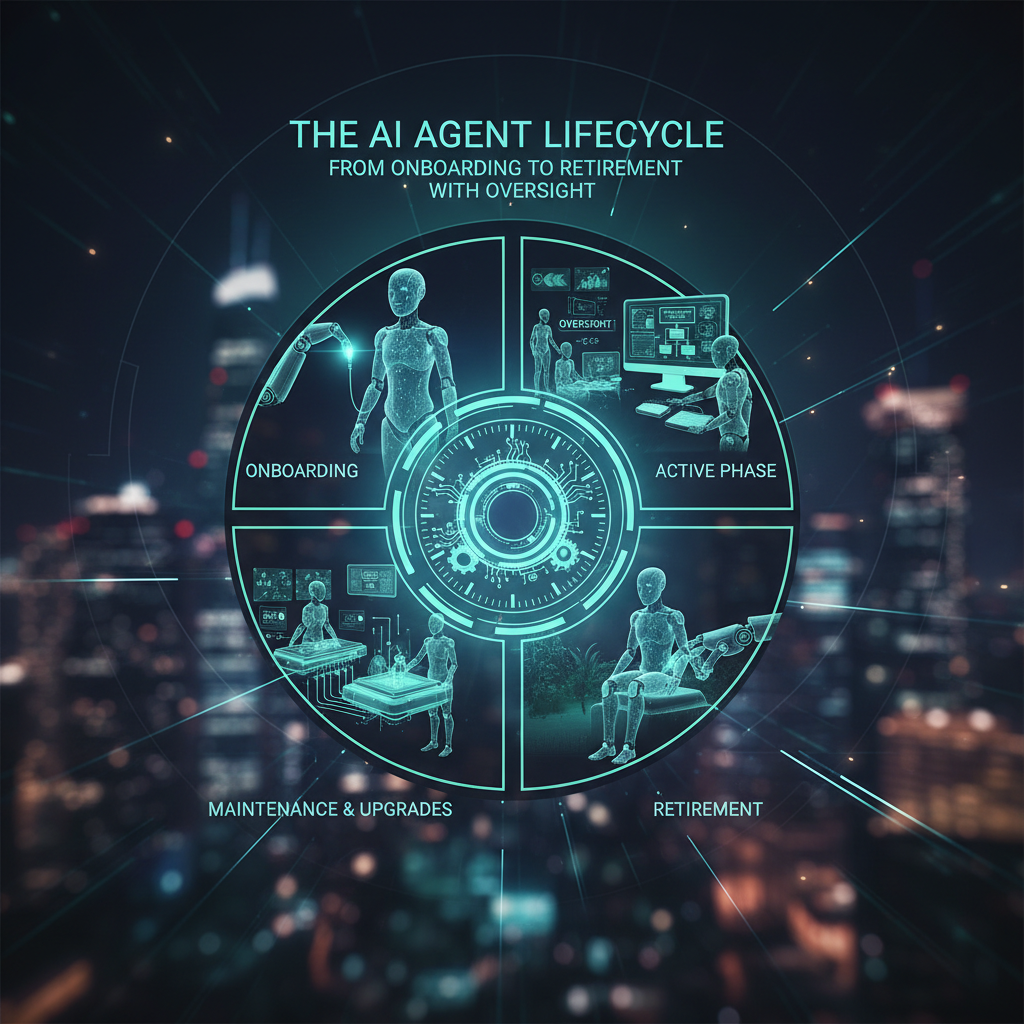
In today's rapidly evolving technological landscape, AI agents are no longer a futuristic concept but a present-day reality transforming how enterprises operate. From automating routine tasks to assisting in complex decision-making, autonomous AI agents are becoming indispensable. However, effectively harnessing their power requires more than just deployment; it demands a structured approach to their entire existence – the AI agent lifecycle. This comprehensive journey, encompassing everything from initial onboarding and seamless deployment to continuous monitoring, iterative refinement, and ultimately, responsible retirement, is critical for operational efficiency, compliance, and ethical AI.
For operational managers, overseeing this lifecycle can seem daunting. How do you ensure your AI agents are deployed correctly? How do you monitor their performance, provide necessary human oversight, and guarantee compliance with emerging regulations like the AI Act 2025? This article will guide you through each stage of the AI agent lifecycle, providing best practices and demonstrating how a specialized Human-in-the-Loop (HITL) governance platform like AgentTask Pro can simplify this complex process, empowering non-technical operators to maintain control and derive maximum value from their AI investments. Understanding and managing the AI agent lifecycle is not just about technology; it's about establishing trust, accountability, and sustainable automation within your organization.
Mapping the Journey of Your AI Agents
Every successful AI agent deployment begins with a clear understanding of its journey, much like any human employee or critical software system. This journey, or the AI agent lifecycle, isn't a linear path but a continuous loop of development, deployment, operation, and refinement, all underpinned by robust governance. Ignoring this lifecycle can lead to unforeseen risks, compliance issues, and underperforming agents. A well-defined lifecycle ensures your AI investments deliver consistent value while adhering to ethical and regulatory standards.
Defining Agent Purpose and Scope
Before an AI agent is even built or acquired, its purpose must be meticulously defined. What problem will it solve? What decisions will it influence or make? Clearly articulating the agent's role, its boundaries, and the specific metrics for its success sets the foundation for effective governance. This initial phase involves collaboration between business stakeholders, AI/ML teams, and compliance officers to ensure alignment with organizational goals and ethical guidelines. Without this clarity, agents can quickly veer off course, creating more problems than they solve.
Pre-Deployment Assessment and Risk Classification
Once the agent's purpose is clear, a thorough pre-deployment assessment is crucial. This involves evaluating potential risks, biases, and vulnerabilities before the agent interacts with real-world data or processes. AgentTask Pro simplifies this with features like automatic risk classification, helping identify high-stakes actions that require more stringent human review. By proactively classifying risks, operational managers can establish appropriate oversight mechanisms from the outset, minimizing negative impacts and ensuring responsible AI automation. This step is vital for demonstrating due diligence and preparing for regulatory scrutiny.
Setting Up Governance Frameworks
Integrating AI agents into existing operational workflows requires a robust governance framework. This includes defining clear roles and responsibilities, setting performance benchmarks, and establishing approval processes. For non-technical operators, this framework needs to be intuitive and accessible. AgentTask Pro's 3-tier permission system (Admin, Reviewer, Viewer) and customizable SLA configurations enable organizations to define who can do what, when, and how, ensuring that every agent's action is accountable. This early stage also involves planning for the necessary human-in-the-loop interventions, ensuring that human oversight is integrated by design, not as an afterthought.
Onboarding and Deployment Best Practices
Successfully bringing AI agents into your operational environment involves more than just plugging them in. It requires careful onboarding, secure deployment, and seamless integration with existing systems. For non-technical operators, this process needs to be straightforward and clearly guided. An efficient onboarding process reduces friction, accelerates time-to-value, and sets the stage for productive AI agent collaboration.
Seamless Agent Integration and Provisioning
Integrating AI agents should be a smooth, rather than a disruptive, process. AgentTask Pro offers framework-agnostic integration capabilities, supporting popular AI agent frameworks like LangChain, AutoGen, and CrewAI, as well as general automation tools like n8n and Zapier, via a public REST API. This flexibility ensures that your diverse AI agent stack can be easily managed from a single pane of glass. Provisioning new agents should involve defining their initial configurations, assigning them to relevant teams or workflows, and setting up their communication channels, such as Slack for intelligent risk notifications.
Establishing Initial Human-in-the-Loop Workflows
During deployment, it's essential to define how humans will interact with and oversee the AI agents. This involves setting up initial approval workflows, determining when human intervention is required, and clarifying the decision-making process. AgentTask Pro’s Kanban-style dashboard provides a visual, real-time overview of tasks (Pending, In Progress, Needs Approval, Completed, Escalated), making it easy for non-technical managers to understand where human attention is needed. This visual management helps operational teams quickly grasp agent activities and intervene precisely when necessary, fostering a collaborative environment between human and AI workforces.
Secure Deployment and Access Control
Security is paramount when deploying AI agents, especially those handling sensitive data or critical operations. This means ensuring secure authentication, managing user permissions, and isolating agent environments where necessary. AgentTask Pro provides secure authentication options (Google, Apple, Email) and a robust 3-tier permission system to control access and actions. For enterprises with stringent security requirements, features like workspace isolation for AI agents ensure sensitive tasks are handled in secure environments. This attention to security from the start builds trust and protects against potential vulnerabilities, a cornerstone of responsible AI automation.
Continuous Monitoring and Iteration
The AI agent lifecycle doesn't end after deployment; it truly begins. Continuous monitoring is crucial to ensure agents perform as expected, identify anomalies, and adapt to changing conditions. This ongoing oversight prevents drift, maintains operational efficiency, and ensures long-term value. Without active monitoring, agents can become black boxes, leading to compliance breaches or suboptimal performance.
Real-time Performance Tracking with Kanban Dashboards
Operational managers need immediate visibility into their AI agents' activities. A Real-time Kanban for AI Agents: Visualize & Manage Your HITL Workflows provides an intuitive, visual representation of task statuses. With AgentTask Pro's Kanban dashboard, managers can track tasks from "Pending" to "Completed," identifying bottlenecks or agents requiring immediate attention. This visual approach democratizes AI oversight, making it accessible even for those without deep technical expertise. Real-time data empowers quick decision-making and proactive intervention, keeping your AI operations smooth and efficient.
Intelligent Alerting and Escalation
Not every agent action requires constant human attention. Effective monitoring focuses human effort where it's most needed. Intelligent notifications via Slack or email, powered by automatic risk classification, ensure that operational managers are alerted only when critical decisions, high-risk tasks, or SLA breaches occur. AgentTask Pro's SLA tracking and automatic escalation features guarantee timely human review and intervention, preventing critical tasks from being overlooked. This selective alerting reduces cognitive load and allows teams to manage a larger fleet of AI agents efficiently.
Performance Analytics and Feedback Loops
Beyond real-time tracking, comprehensive analytics are vital for understanding agent performance over time. Metrics such as approval rates, reviewer speed, and SLA compliance provide insights into the effectiveness of both AI agents and human oversight processes. AgentTask Pro's analytics dashboard offers these insights, including ROI analytics for executives, allowing organizations to measure the true impact of their AI investments. This data-driven feedback loop is essential for iterative improvement, enabling teams to refine agent parameters, adjust workflows, and continuously enhance operational efficiency.
Robust Governance and Compliance Throughout the Lifecycle
As AI agents become more sophisticated and integrated into critical business functions, the need for robust governance and compliance has never been more urgent. Regulatory landscapes, such as the upcoming AI Act 2025, are emphasizing accountability, transparency, and human oversight. Integrating governance throughout the AI agent lifecycle is no longer optional; it's a strategic imperative.
Ensuring Regulatory Compliance (e.g., AI Act 2025)
The EU AI Act 2025 is setting a global benchmark for AI regulation, particularly for high-risk AI systems. Organizations deploying AI agents must ensure their operations align with these new legal requirements. AgentTask Pro is uniquely positioned in the market by actively addressing Navigating AI Act 2025 Compliance: Your Essential Guide for AI Agents. Features like certified audit trails, automatic risk classification, and transparent human-in-the-loop approval processes are designed to provide the necessary tools for demonstrating compliance. This proactive approach helps mitigate legal and reputational risks associated with non-compliant AI deployments.
Comprehensive Audit Trails and Transparency
Accountability in AI is impossible without transparency. A complete and immutable audit trail of all AI agent actions and human interventions is fundamental for internal reviews, external audits, and demonstrating compliance. AgentTask Pro provides a certified audit trail that records every decision, modification, and escalation, creating an indisputable history of an agent's activities. This level of transparency builds trust among stakeholders and provides the necessary evidence for demonstrating responsible AI practices, crucial for highly regulated industries like banking, insurance, and healthcare.
Contextual Reasoning and Risk-Based Approval
Not all AI agent decisions carry the same weight. A truly intelligent governance platform incorporates contextual reasoning to understand the implications of an agent's proposed action. This allows for risk-based approval, where high-risk decisions automatically trigger more stringent human review, while lower-risk actions might be approved with sampling-based oversight or fully automated. AgentTask Pro integrates contextual reasoning capabilities, allowing non-technical operators to understand why an agent made a recommendation and to provide informed feedback. This nuanced approach optimizes human intervention, focusing attention on critical junctures and improving overall operational efficiency.
Advanced Oversight Features for Non-Technical Operators
The complexity of AI agents often creates a barrier for non-technical operational managers. AgentTask Pro is specifically designed to bridge this gap, providing advanced human-in-the-loop features that are intuitive and powerful. These features empower managers to maintain granular control without needing to understand underlying code or complex AI models.
"Approve with Modifications" for Granular Control
One of the most requested, yet rarely implemented, features in HITL platforms is the ability to "Approve with Modifications." Traditional systems often force a binary approve/reject decision, leading to inefficiency and frustration when an agent's output is mostly correct but needs slight adjustments. AgentTask Pro's Approve with Modifications: The Next Evolution in AI Agent Approval Workflows feature allows human reviewers to directly edit an agent's output before approving it. This significantly streamlines workflows, reduces rework, and provides valuable, specific feedback to continuously improve agent performance, turning a simple approval process into a powerful collaborative feedback loop.
Sampling-Based and Risk-Based Approvals
For high-volume AI operations, manually reviewing every single agent action is impractical. AgentTask Pro addresses this with intelligent sampling-based approval mechanisms. This allows managers to approve a subset of an agent's actions, trusting the system's performance on similar tasks, while still maintaining human oversight. Coupled with risk-based approval, where high-risk actions are always flagged for mandatory review regardless of sampling, this approach ensures efficient oversight without compromising on safety or compliance. It's about intelligently allocating human resources where they are most effective.
Multi-Reviewer SLA and Executive Dashboards
Critical AI decisions often require consensus or review from multiple stakeholders. AgentTask Pro supports multi-reviewer SLA, allowing organizations to define complex approval hierarchies and service level agreements, ensuring timely review by the right people. For leadership, the CEO dashboard provides a high-level overview of AI agent performance, ROI analytics, and compliance status. This executive visibility transforms AI from a technical black box into a strategic asset, providing actionable insights into its impact on the business. For a deeper dive into comprehensive management, consider The Ultimate HITL Governance Platform: AgentTask Pro Overview.
Responsible Retirement of AI Systems
Even the most sophisticated AI agents eventually reach the end of their operational lifespan. This could be due to obsolescence, changing business requirements, or the development of more advanced alternatives. Responsible retirement is a critical, often overlooked, phase of the AI agent lifecycle that ensures data integrity, minimizes residual risks, and facilitates a smooth transition.
Decommissioning and Data Archiving
When an AI agent is no longer needed, it must be carefully decommissioned. This involves gracefully removing it from operational workflows, ensuring no critical tasks are disrupted, and archiving its operational data and audit trails. The certified audit trail generated throughout the agent's lifecycle becomes invaluable here, providing a complete history of its decisions and human interventions. Proper data archiving is essential for future reference, compliance audits, and post-mortem analysis, ensuring accountability even after an agent is no longer active.
Impact Assessment and Knowledge Transfer
Before final retirement, conducting an impact assessment helps understand the agent's overall contribution and any potential void its removal might create. This assessment also informs knowledge transfer processes, documenting lessons learned from its deployment, performance, and governance. This knowledge can then be applied to future AI agent development and deployment, contributing to a continuous improvement cycle within the organization's AI strategy. Capturing this institutional knowledge maximizes the long-term value of your AI investments.
Ethical Considerations in Retirement
Responsible retirement also involves ethical considerations. If an AI agent has been interacting with customers or making decisions that affect individuals, its discontinuation must be handled transparently and ethically. This might involve clear communication to affected parties, ensuring continuity of service, and mitigating any potential biases or unintended consequences arising from its removal. Maintaining human oversight even during the decommissioning phase ensures that ethical guidelines are upheld until the very end of an AI agent's active service.
Conclusion
Managing the AI agent lifecycle is a complex, yet essential, endeavor for any enterprise leveraging autonomous AI. From meticulously defining purpose and securing deployment to continuous monitoring, robust governance, and responsible retirement, each stage demands careful attention and effective tools. Ignoring these phases can lead to operational inefficiencies, compliance headaches, and a loss of trust in your AI initiatives.
AgentTask Pro is purpose-built to address these challenges, offering the only agnostic Human-in-the-Loop governance platform designed for non-technical operators. With its intuitive Kanban dashboards, intelligent risk notifications, multi-reviewer SLA, "Approve with Modifications" feature, and strong emphasis on AI Act compliance, AgentTask Pro empowers operational managers to oversee and manage their AI agents with unprecedented control and transparency. By providing contextual reasoning and a certified audit trail, AgentTask Pro ensures that your AI agents are not only efficient but also accountable and ethical throughout their entire operational life.
Ready to gain complete control over your AI agents and ensure responsible, compliant, and efficient AI operations? Explore AgentTask Pro today or View Our Pricing Plans to find the perfect solution for your enterprise.