Escalation Rules for AI Agents: Never Miss a Critical Decision
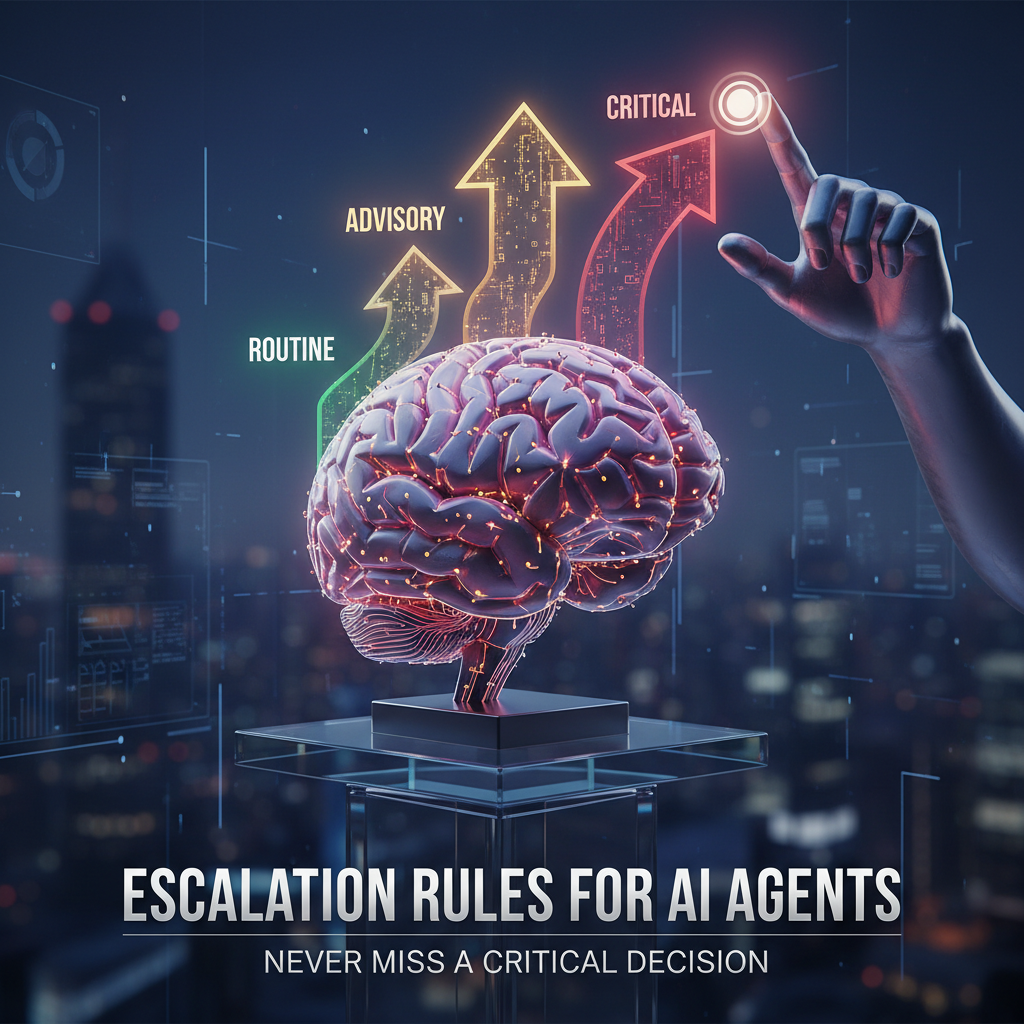
As autonomous AI agents take on increasingly complex and critical tasks, the need for robust human oversight becomes paramount. While AI agents excel at automation, there are always moments when human judgment is indispensable – whether for complex approvals, ethical dilemmas, or high-risk operations. The challenge, however, isn't just identifying these moments, but ensuring that critical decisions never fall through the cracks. This is where well-defined AI agent escalation rules become not just beneficial, but absolutely essential.
Imagine an AI agent making a high-stakes financial transaction or providing critical healthcare advice. A delay in human review or a missed approval could lead to significant financial loss, compliance breaches, or even harm. Effective escalation rules act as the safety net, guaranteeing that every critical AI decision receives timely human attention. This article will explore why robust escalation mechanisms are vital for responsible AI deployment, the common pitfalls of inadequate systems, and how AgentTask Pro empowers operational managers to design and implement automated escalation paths that ensure no critical task is ever overlooked.
We'll delve into the intricacies of designing these intelligent systems, showcasing how platforms like AgentTask Pro deliver intelligent notifications AI can provide contextual alerts, multi-reviewer workflows, and SLA automation to keep your AI operations both efficient and compliant. By the end, you'll understand how to transform potential risks into opportunities for enhanced control and accountability in your autonomous AI ecosystem.
The Hidden Cost of Unmanaged AI Approvals
The promise of AI agents lies in their ability to automate and scale operations. However, without a meticulously managed approval and escalation process, this promise can quickly turn into a liability. Every AI-driven action, particularly in regulated industries like banking, insurance, and healthcare, carries a degree of risk. When human approval is required, but the system lacks proper follow-through, the potential for significant negative consequences increases dramatically.
Delays, Risks, and Compliance Gaps
A delay in approving an AI agent's recommendation can halt critical business processes, impacting efficiency and customer satisfaction. More severely, a completely missed approval for a high-risk action could lead to costly errors, legal liabilities, or severe reputational damage. Consider an AI processing loan applications; if a high-value approval requiring human review is overlooked, the company faces financial exposure. From a compliance perspective, regulations like the upcoming AI Act 2025 and GDPR demand clear audit trails and demonstrable human oversight for certain AI applications. A failure in escalation directly translates to a compliance gap, exposing organizations to hefty fines and legal action. Unmanaged approvals are not merely an operational inconvenience; they are a direct threat to your organization's financial health, legal standing, and public trust.
Identifying Critical AI Decisions
Not all AI agent tasks require the same level of human intervention. The first step in designing effective automated escalation paths is to accurately identify which AI decisions are truly "critical." This often involves a multi-faceted assessment:
- Risk Level: Does the decision involve sensitive data, significant financial impact, or potential harm to individuals? AgentTask Pro’s automatic risk classification feature helps categorize tasks.
- Compliance Mandates: Are there specific regulatory requirements for human review or approval for certain types of AI outputs?
- Contextual Nuance: Does the decision operate in a domain where AI might lack full contextual understanding, necessitating human judgment?
- Novelty/Uncertainty: Is the AI agent operating in a new or ambiguous scenario where precedents are not yet established?
By clearly defining what constitutes a critical decision, operational managers can ensure that escalation resources are focused where they matter most, preventing alert fatigue while safeguarding against high-impact failures.
Beyond Simple Notifications: Why Automation is Key
Many organizations rely on basic email or chat notifications for AI agent alerts. While a good start, this approach quickly becomes insufficient as AI operations scale. A simple notification doesn't guarantee receipt, understanding, or action. True AI agent escalation requires automation – a system that understands the urgency, tracks deadlines, and intelligently routes tasks to the right person or team when initial reviews are missed. Manual tracking of pending approvals is prone to human error and simply cannot keep pace with an autonomous workforce. Automated systems ensure that:
- Notifications are sent to the correct individual or group.
- Reminders are automatically triggered if no action is taken.
- Tasks are automatically re-assigned or escalated to higher authority levels when SLAs are breached.
- A clear audit trail of all actions and inactions is maintained, supporting accountability and compliance.
This level of intelligent automation is crucial for bridging the gap between AI's speed and the necessity of human oversight, making automated escalation paths an indispensable component of any modern AI governance strategy.
Crafting Robust Escalation Policies for Autonomous AI
Building an effective escalation system for AI agents is more than just setting up alerts; it's about designing a resilient workflow that proactively manages risk and ensures accountability. This involves careful planning and integration of various elements to create a seamless Human-in-the-Loop (HITL) process.
Defining Tiers and Timeframes
The foundation of robust AI agent escalation lies in clearly defined tiers and timeframes. A multi-tiered escalation strategy ensures that tasks receive prompt attention at the lowest possible level, only progressing higher if necessary.
- Tier 1 (Initial Reviewer): This is typically the operational manager or domain expert first assigned to the AI agent's task. A specific timeframe (e.g., 30 minutes, 2 hours, 1 business day) is allocated for their review.
- Tier 2 (Secondary Reviewer/Team Lead): If Tier 1 fails to act within the stipulated time, the task automatically escalates to Tier 2. This could be a team lead, a specialized compliance officer, or another designated expert. Their timeframe for action is also defined.
- Tier 3 (Manager/Executive): For high-priority or highly sensitive critical AI decisions that remain unresolved, the task escalates further, potentially reaching a senior manager or even a CEO dashboard. This ensures executive visibility and intervention when required.
Each tier should have clearly defined responsibilities and authority levels, ensuring that the right eyes are on the task at the right time.
Multi-Reviewer Pathways and Role-Based Routing
Complex AI decisions often benefit from the input of multiple stakeholders. An effective escalation system must support multi-reviewer approval pathways, allowing tasks to be routed to several individuals concurrently or sequentially. For instance, a financial transaction might require approval from both a risk analyst and a compliance officer. AgentTask Pro facilitates this with its 3-tier permission system (Admin, Reviewer, Viewer) and its ability to manage assignments.
Role-based routing ensures that notifications and tasks are directed to individuals based on their function, expertise, and authority. This means a legal compliance issue won't be escalated to a marketing manager, but directly to the legal team. This intelligent routing optimizes response times and ensures that the most qualified personnel are involved, avoiding unnecessary delays or miscommunications. For more insights on collaborative governance, explore our article on Multi-Reviewer Approval for AI Agents: Collaborative Governance at Scale.
Contextual Triggers and Intelligent Risk Classification
Moving beyond static rules, modern automated escalation paths leverage contextual triggers. This means the system doesn't just escalate based on time, but also on the nature of the AI agent's output. For example:
- An AI agent's output might be automatically classified as "high risk" if it deviates significantly from established patterns or proposes an action with potentially large financial implications. This immediately triggers an expedited escalation.
- A keyword detection in an AI-generated customer response could flag it for immediate human review due to sensitive content.
- AI agents operating within specific regulatory frameworks (e.g., HIPAA in healthcare) might have stricter, automatically applied escalation protocols for certain types of data handling.
Integrating intelligent notifications AI means these alerts are not just "there's a problem," but "there's a problem of this type, requiring this kind of expertise, due at this time." AgentTask Pro's automatic risk classification and intelligent risk notifications via Slack provide this level of detail, empowering reviewers to make informed decisions quickly.
AgentTask Pro's Dynamic Escalation Engine in Action
AgentTask Pro is purpose-built to address the complexities of AI agent oversight, offering a comprehensive platform that integrates seamlessly with your existing AI stack. Its dynamic escalation engine provides the tools operational managers need to confidently manage and oversee autonomous AI agents without needing technical expertise.
Kanban-Powered Visual Workflow and Real-time Status
At the heart of AgentTask Pro's system is a intuitive Kanban-style dashboard. This visual interface transforms abstract AI agent tasks into concrete, trackable items. Operational managers can see at a glance the real-time status of every AI task: Pending, In Progress, Needs Approval, Completed, and Escalated. This transparency is crucial for managing critical AI decisions. When a task escalates, its status changes instantly, drawing immediate attention. Reviewers can easily filter tasks, prioritize urgent items, and understand exactly where a task is in the approval pipeline. This visual management drastically reduces the chances of anything being missed and empowers non-technical operators to oversee complex AI workflows with ease. To learn more about this visual approach, check out our piece on Kanban AI Task Management: A Visual Approach to AI Agent Governance.
Intelligent Notifications and Seamless Integrations (Slack, Email)
AgentTask Pro's intelligent notifications AI engine is designed to cut through the noise. Instead of generic alerts, managers receive contextual notifications tailored to the urgency and nature of the escalated task. These alerts are pushed through preferred channels like Slack, ensuring immediate visibility where teams already collaborate. For instance, an escalation due to an SLA breach might include a direct link to the task in the Kanban board, highlighting the specific AI agent's output and the reason for the escalation.
Beyond immediate alerts, the platform's framework-agnostic integration capabilities mean it connects with popular AI frameworks like LangChain, AutoGen, and CrewAI, as well as automation tools like n8n and Zapier. This ensures that no matter your AI agent's origin, its critical tasks can be fed into AgentTask Pro's governance framework, and relevant stakeholders receive timely, actionable alerts. For a deeper dive into how context enhances alerts, read about Intelligent Notifications for AI: Contextual Alerts for Informed Human Decisions.
"Approve with Modifications" for Granular Control
A common frustration in AI agent approval workflows is the binary choice: approve or reject. Often, a reviewer might see value in an AI's output but identify a minor flaw or a necessary adjustment. AgentTask Pro tackles this with its unique "Approve with Modifications" feature. This capability allows reviewers to:
- Approve: Accept the AI agent's output as is.
- Reject: Deny the AI agent's output entirely, often with feedback.
- Approve with Modifications: Accept the core of the AI agent's output while simultaneously providing specific, in-line edits or instructions for the AI agent (or a human assistant) to implement.
This granular control is invaluable for fine-tuning AI agents, providing precise feedback, and accelerating the improvement loop without entirely restarting the process. It's a feature "demanded everywhere but implemented nowhere" by competitors, offering a significant advantage in iterative AI agent development and oversight, ensuring critical AI decisions are not just managed, but perfected.
Ensuring Timely and Informed Human Intervention
The ultimate goal of AI agent escalation rules is to ensure that human intervention, when needed, is not only timely but also highly effective. This requires a system that prioritizes, streamlines, and provides the necessary context for human decision-makers.
SLA Automation: Guaranteeing Accountability
Service Level Agreements (SLAs) are fundamental to operational efficiency, and their application to AI agent oversight is a game-changer. AgentTask Pro's SLA automation AI agents feature allows managers to define clear response and resolution times for human reviews. If an AI agent's task requiring human approval breaches its assigned SLA, the system automatically triggers an escalation. This could mean sending increasingly urgent notifications, reassigning the task to a different reviewer with a shorter deadline, or elevating it to a senior manager.
This automated accountability ensures that critical AI decisions are never left in limbo. It transforms passive oversight into an active, deadline-driven process, significantly reducing the risk of costly delays and reinforcing the importance of human responsiveness. For more details on this crucial feature, refer to our article on SLA Automation for AI Agents: Guaranteeing Timely Human Approval.
Audit Trails for Unwavering Transparency
In the world of AI governance, transparency and accountability are non-negotiable. Every step in the AI agent's workflow, especially those involving human review and escalation, must be meticulously recorded. AgentTask Pro provides a certified audit trail that logs every action:
- When an AI agent initiated a task.
- Who reviewed it, when, and their decision (approve, reject, modify).
- All escalation paths triggered, including reviewers involved and their actions.
- Any modifications made and the reasons provided.
This comprehensive record is invaluable for:
- Compliance: Demonstrating adherence to regulatory requirements (e.g., AI Act, GDPR).
- Troubleshooting: Quickly identifying bottlenecks or errors in the workflow.
- Accountability: Clearly attributing decisions and actions to specific individuals or teams.
- Learning: Analyzing past escalations to refine AI agent behavior and human oversight processes.
This unwavering transparency builds trust in your AI systems and provides the necessary evidence for internal audits or external regulatory scrutiny.
Empowering Non-Technical Operators
One of AgentTask Pro's core differentiators is its design for non-technical operators. The complexity of AI agent escalation and governance is abstracted away, allowing operational managers to focus on business outcomes rather than technical configurations. Through intuitive interfaces, drag-and-drop workflow builders, and plain-language settings, users can:
- Define escalation tiers and rules without writing code.
- Configure intelligent notifications AI for specific teams or individuals.
- Monitor AI agent performance and approval rates from a clear dashboard.
- Approve, reject, or modify AI outputs with contextual reasoning.
This empowerment democratizes AI oversight, moving it out of the exclusive domain of AI/ML engineers and into the hands of those who understand the business impact of critical AI decisions. It ensures that human judgment is integrated seamlessly and effectively into the AI lifecycle, fostering a truly collaborative and responsible AI environment. To understand the broader impact, read our guide on Human Oversight for AI Agents: Maintaining Control in Autonomous Systems.
FAQ: AI Agent Escalation and Oversight
Q: Why are escalation rules crucial for AI agents?
A: Escalation rules are crucial for AI agents to ensure that critical decisions requiring human judgment are never missed or unduly delayed. They provide a safety net, guaranteeing timely human intervention, managing risks, and ensuring compliance, especially in high-stakes operational environments.
Q: How does AgentTask Pro handle complex multi-reviewer approvals?
A: AgentTask Pro supports multi-reviewer pathways and role-based routing. You can define multiple tiers of reviewers, set specific timeframes for each, and route tasks based on roles or expertise. This ensures complex critical AI decisions get attention from all necessary stakeholders.
Q: Can non-technical users manage AI agent escalation in AgentTask Pro?
A: Absolutely. AgentTask Pro is specifically designed for non-technical operational managers. Its intuitive Kanban dashboard, plain-language settings, and visual workflow tools allow users to easily configure, monitor, and manage AI agent escalation rules without any coding knowledge.
Q: What distinguishes AgentTask Pro's escalation from basic alerts?
A: AgentTask Pro goes beyond basic alerts by offering intelligent notifications AI that are contextual, proactive, and integrated with SLA automation AI agents. It doesn't just notify; it ensures accountability, tracks deadlines, provides comprehensive audit trails, and offers granular control like "Approve with Modifications" to truly facilitate timely and informed human intervention.
Conclusion
In an era increasingly defined by autonomous AI agents, the ability to effectively manage and escalate critical AI decisions is no longer a luxury—it's a necessity for any enterprise committed to responsible AI. The potential costs of missed approvals, from financial penalties to reputational damage and compliance breaches, are too high to ignore. By implementing robust AI agent escalation rules, organizations can confidently deploy AI agents, knowing that intelligent oversight mechanisms are in place to ensure ethical, compliant, and efficient operations.
AgentTask Pro provides the comprehensive, user-friendly platform that empowers operational managers to design, monitor, and enforce these crucial escalation pathways. With its dynamic engine, Kanban-powered workflows, intelligent notifications AI, and unique "Approve with Modifications" feature, it ensures that every critical AI decision receives the right human attention at the right time. Don't let your autonomous agents operate in a vacuum; embrace the power of effective human-in-the-loop governance to unlock AI's full potential while mitigating its risks.
Ready to take control of your AI agent operations and ensure no critical decision is ever missed? Explore AgentTask Pro's Pricing Plans today and discover how our platform can transform your AI governance strategy.